
Elon Musk
Elon Musk Suddenly Says He’s Not MAGA — After Spending Hundreds of Millions Helping Trump While American Workers Lost Their Jobs
From “Dark MAGA” to political amnesia, the billionaire tech mogul is attempting to reinvent himself as a moderate following Republican election defeats. But the economic consequences of the policies he helped promote are not nearly as easy to erase.

By Dennis Byron | November 23, 2026
WASHINGTON, D.C. — Apparently, Elon Musk has discovered a groundbreaking new technology: political amnesia.
The billionaire businessman who enthusiastically embraced Donald Trump's MAGA movement, poured hundreds of millions of dollars into Republican campaigns, and helped oversee sweeping federal workforce reductions is now informing the American public that he isn't really MAGA after all.
That's right. The man who once proudly proclaimed himself “Dark MAGA” is apparently ready to turn off the lights, pack up the merchandise, and pretend he was only visiting.
During the November 18 New York Times DealBook Summit, Musk declared, “I'm not MAGA,” describing himself as politically moderate and suggesting he wasn't entirely sure what the movement represented.
This sudden identity crisis comes after Democrats delivered major defeats to Republicans in the 2026 midterm elections, capturing control of both chambers of Congress. Musk acknowledged feeling foolish about spending enormous amounts of money to support losing Republican candidates.
One might reasonably wonder how a man capable of building reusable rockets, developing artificial intelligence systems, and operating electric-car factories could have such difficulty remembering the political movement he helped finance.
Perhaps political memory simply isn't included in the latest Tesla software update.
Hundreds of Millions Spent — And Now He's a Moderate?
Musk's political transformation would be remarkable if it weren't so conveniently timed.
During the 2024 presidential campaign, Musk publicly embraced Trump's movement, appeared at rallies, encouraged voters to support Republicans, and became one of the most recognizable billionaire allies of the MAGA coalition.
After Trump's victory, Musk played a leading role in the administration's Department of Government Efficiency, commonly known as DOGE, which pursued aggressive reductions in federal spending and staffing.
Fast-forward to November 2026, and the political landscape has changed.
According to the Associated Press, Musk spent more than $400 million supporting Trump-aligned Republican candidates in the midterm elections, including approximately $200 million backing Texas Republican Senate nominee Ken Paxton, who lost to Democrat James Talarico.
Musk now says his political views are moderate, that both parties have positive and negative qualities, and that his spending may have been excessive.
How convenient.
When Republicans appeared politically unstoppable, Musk was enthusiastically MAGA. When Republicans suffered historic electoral setbacks, he suddenly became a thoughtful independent searching for balance.
And while billionaires can afford political reinventions, American workers who lost their livelihoods under the administration's policies don't have quite the same luxury.
The American Jobs Lost While MAGA Promised an Economic Revolution
Trump and his allies repeatedly promised that their policies would restore American manufacturing, protect domestic employment, eliminate government waste, and deliver unprecedented prosperity.
But several major policy initiatives produced measurable job losses, heightened costs for businesses, or disrupted industries that employ millions of Americans.
The distinction matters: not every job lost during Trump's presidency was directly caused by one administration policy. Automation, changing consumer demand, interest rates, and longstanding industry trends also contributed.
Nevertheless, federal labor statistics and independent economic research reveal serious employment consequences associated with several of the administration's signature decisions.
1. DOGE and the federal workforce reductions
One of the clearest employment casualties of Trump's second administration was the federal workforce itself.
The Bureau of Labor Statistics reported that federal employment declined by approximately **287,000 jobs in 2025, the largest annual reduction since 1946.
These reductions occurred during the same year Musk became the public face of DOGE and the administration pursued widespread layoffs, agency restructuring, and incentives for federal employees to leave government service.
Many affected employees worked in government services, administration, scientific research, regulatory oversight, and public programs.
Not every departure was an involuntary firing; the employment decline also included voluntary exits and other workforce reductions.
Yet the contradiction remains striking.
An administration promising American workers a brighter future celebrated government downsizing as fiscal discipline, while hundreds of thousands of federal positions disappeared.
For the workers who lost their jobs, apparently the American Dream needed a budget adjustment.
2. Tariffs and the manufacturing jobs that failed to return
Trump repeatedly described tariffs as essential tools for reviving American manufacturing.
His administration imposed import duties covering numerous products and materials, including steel, copper, and other industrial inputs.
The problem? American manufacturers often purchase those materials themselves.
When imported components become more expensive, domestic factories can face higher production costs, tighter profit margins, reduced orders, and difficult staffing decisions.
According to the Bureau of Labor Statistics, American manufacturing lost approximately **113,000 jobs during 2025.
The agency also noted that tariffs increased costs for manufacturers, while industry executives cited trade uncertainty as an obstacle to long-term investment planning. Manufacturing had already lost 179,000 jobs in 2024, underscoring that its difficulties predated the second Trump administration.
There was some subsequent recovery: the October 2026 employment report showed manufacturing jobs increasing during that month and over the preceding year. That improvement should not be ignored.
Still, the earlier losses and additional business costs raise an obvious question about whether aggressive tariffs delivered the promised manufacturing renaissance.
It turns out that making imported materials more expensive doesn't automatically make factories hire more Americans.
Who could have imagined?
3. Small businesses suffered while tariffs drove up costs
America's smallest businesses were among those hit hard during the administration's trade-policy overhaul.
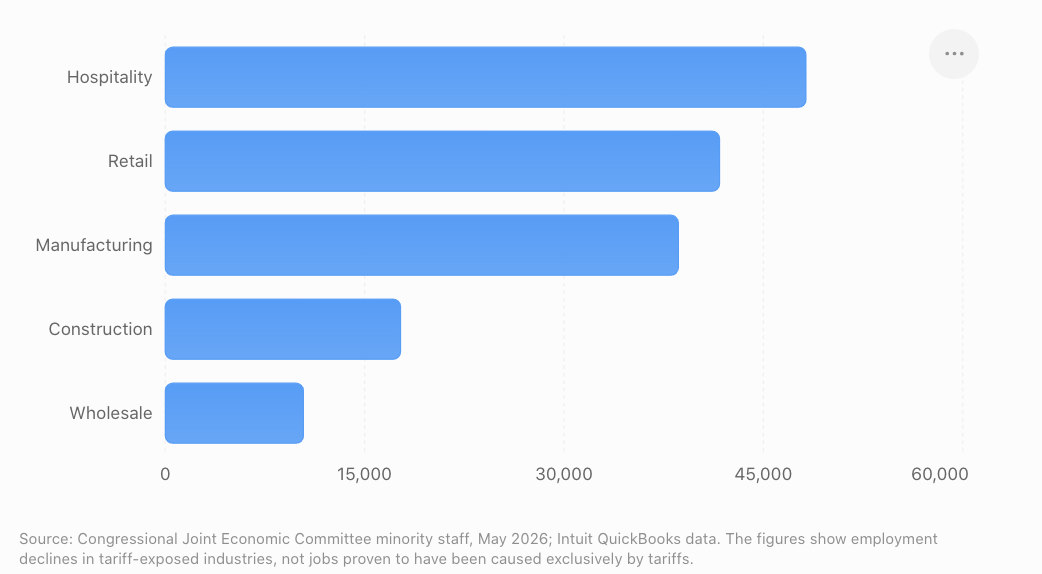
A May 2026 report from the Democratic minority staff of Congress's Joint Economic Committee, using Intuit QuickBooks employment data, found that businesses with fewer than 10 employees experienced significant employment declines.
In industries particularly exposed to tariffs, the report identified **156,600 lost jobs between April 2025 and April 2026.
Job losses at the smallest businesses in tariff-exposed industries
Source: Congressional Joint Economic Committee minority staff, May 2026; Intuit QuickBooks data. The figures show employment declines in tariff-exposed industries, not jobs proven to have been caused exclusively by tariffs.
The committee attributed much of the pressure to tariffs and trade uncertainty, although the data do not establish that tariffs caused every recorded job loss.
Joint Economic Committee
The administration's economic argument was that short-term trade disruption would ultimately strengthen domestic businesses and bring jobs back to America.
But for a small restaurant, manufacturer, retailer, or construction company struggling with increased costs, promises of future prosperity do little to cover today's payroll.
Apparently, making America great again came with an invoice — and small-business owners were expected to pay it.
4. Clean energy rollbacks and thousands of disappearing jobs
Perhaps one of the most striking contradictions involved the clean energy industry.
Trump's administration and congressional Republicans moved to scale back incentives supporting renewable energy, electric vehicles, battery manufacturing, and other clean technologies.
Those actions included changes enacted through the July 2025 One Big Beautiful Bill Act, which curtailed important tax incentives and funding mechanisms.
According to E2, a business organization focused on environmental and economic policy, the U.S. clean energy sector lost 36,949 jobs during 2025**, ending four consecutive years of employment growth.
The group linked the reversal in part to federal policy changes and reported extensive project cancellations.
Even more concerning, a separate economic modeling analysis commissioned by E2 estimated that 216 canceled, closed, or reduced clean energy projects could result in approximately **468,000 jobs no longer being supported**, including projected construction and permanent employment.
That figure represents modeled jobs foregone — not 468,000 people already laid off.
The irony should not escape anyone.
Musk built much of his business empire around electric vehicles and energy storage. Yet the political movement he helped elevate supported policies that undermined incentives for industries closely associated with Tesla's own products.
Perhaps the only thing more confusing than Musk's newfound political moderation is supporting a movement whose energy policies can work against your own industry's growth.
5. Immigration enforcement and disruptions to American businesses
Trump's aggressive immigration enforcement policies were promoted as a way to protect American jobs and increase employment opportunities for U.S.-born workers.
But the economic results have been more complicated.
Construction companies, agricultural producers, food processors, and hospitality businesses have reported shortages and operational disruptions associated with immigration enforcement.
A March 2026 Los Angeles Times examination found little evidence that the crackdown had produced a significant employment boost for U.S.-born workers.
The chief executive of the Home Builders Institute reported that some construction projects temporarily shut down when employees stopped reporting to work amid immigration enforcement fears.
Los Angeles Times
Agricultural industry representatives have also warned that restrictions on immigrant labor threaten food production and American farming operations.
Those disruptions can reduce output and threaten related American jobs, even though a comprehensive count of jobs lost directly because of immigration enforcement is not established.
The administration's supporters argue that stricter enforcement protects wages, upholds immigration laws, and encourages employers to recruit American citizens.
Critics counter that removing workers without addressing labor shortages can damage industries that already struggle to find employees.
The economic question remains straightforward: How does shutting down a construction project create more construction jobs?
Apparently, that's a mathematical equation best left to the billionaires.
The Economic Scorecard
The following figures illustrate the employment losses and risks reported across different industries and policy areas. They should not be added together as one national job-loss total because they cover overlapping periods, different worker populations, and different methods of measurement.
What makes Musk's transformation especially noteworthy is that he is not some ordinary voter who reluctantly supported a presidential candidate.
He was a major financier of the Republican political operation, a prominent campaign surrogate, and a central figure in the administration's effort to restructure the federal government.
And now, with Democrats preparing to assume control of Congress in January 2027, Musk is embracing a considerably less partisan public identity.
That timing is particularly interesting because Democrats have pledged to investigate major technology companies and their dealings with the Trump administration.
Musk's relationships with government officials, his businesses' federal interests, and his role in DOGE could all attract greater scrutiny.
Of course, Musk has every right to change his political views.
Americans should welcome genuine political independence, especially when powerful business leaders recognize that no single party deserves unconditional allegiance.
But changing one's political identification does not erase the decisions made while operating under the old one.
And let's not confuse political moderation with political convenience.
There is a difference between learning from mistakes and simply changing your wardrobe when the election results turn ugly.
What About the Workers Who Cannot Rebrand Their Way Out of Unemployment?
For Americans who have lost federal positions, struggled to keep small businesses operating, or watched planned manufacturing investments disappear, Musk's political transformation may be difficult to celebrate.
A billionaire can spend hundreds of millions of dollars on an election, lose, and casually describe the experience as foolish.
A laid-off worker doesn't have that luxury.
A family that loses its primary source of income cannot simply announce that it no longer identifies with unemployment.
And a small-business owner forced to close after mounting costs and declining sales cannot retroactively declare the business politically independent and expect the bills to disappear.
That is the larger issue surrounding Musk's retreat from the MAGA label.
The consequences of public policy are not limited to election results, political endorsements, or social media arguments.
They extend into American homes, businesses, factories, farms, and communities.
Trump and his supporters point to subsequent manufacturing gains, private investment, stronger border enforcement, and efforts to reduce government spending as evidence that their economic approach is producing benefits. The October 2026 jobs report, for example, recorded 165,000 new nonfarm payroll jobs and 19,000 additional manufacturing jobs.
2026 M10 Results
Those gains deserve acknowledgment.
But so do the losses, the disruptions, and the promised jobs that failed to materialize.
The Final Question: Is Musk Abandoning MAGA, or Is MAGA Becoming Bad for Business?
Perhaps Musk has genuinely reconsidered his politics.
Perhaps he has concluded that political extremism undermines economic progress and that bipartisan cooperation offers a better path forward.
Or perhaps the world's richest man has simply realized that an unpopular political brand is no longer an attractive investment.
Whatever the explanation, his latest declaration raises an accountability question that should not disappear beneath the jokes about his sudden conversion to moderation.
Where was that concern for balance and responsible governance when his political allies were implementing policies that cost Americans their jobs?
Musk may be ready to move beyond MAGA.
But the American workers affected by federal layoffs, trade disruptions, and canceled economic investments are still dealing with the consequences of decisions made while he was proudly standing alongside the movement.
The irony is almost too perfect.
The man who helped sell America a political revolution now appears to be requesting a refund.
Unfortunately, for many American workers, all sales were final.


Join the conversation
0 approved commentsRegistered readers only. Every comment is reviewed by HHE before it appears publicly. Keep it respectful, relevant, and free of personal information or threats.
Loading reader options…
No approved comments yet. Be the first to add your perspective.